Refrigeration in Record Time
2.9 MW of refrigeration capacity: from design to completion in record time.
NH₃/CO₂ cascade refrigeration for a fully automated cold storage facility.
Following the loss of an existing facility in May 2024, a new, future-proof cold storage facility had to be built within a very short timeframe. This large-scale project brought together high refrigeration capacity, reliability, energy efficiency and a demanding schedule.
Wijbenga supported the refrigeration contractor with technical engineering, component selection and the supply of key parts of the refrigeration system. The chosen solution: an NH₃/CO₂ cascade system with a total refrigeration capacity of 2,900 kW.
From the initial specifications in the summer of 2024 to the delivery of the main components in June 2025, the project required direct communication, technical expertise and close cooperation.
The challenge: high capacity, limited ammonia charge
The new cold storage facility comprises seven fully automated freezer rooms, each accommodating approximately 10,000 pallet positions, at a storage temperature of −20°C.
Key design requirements included the short project timeline, an NH₃ charge below 1,500 kg, reliable refrigerant distribution and energy-efficient operation.
The solution: NH₃/CO₂ cascade refrigeration
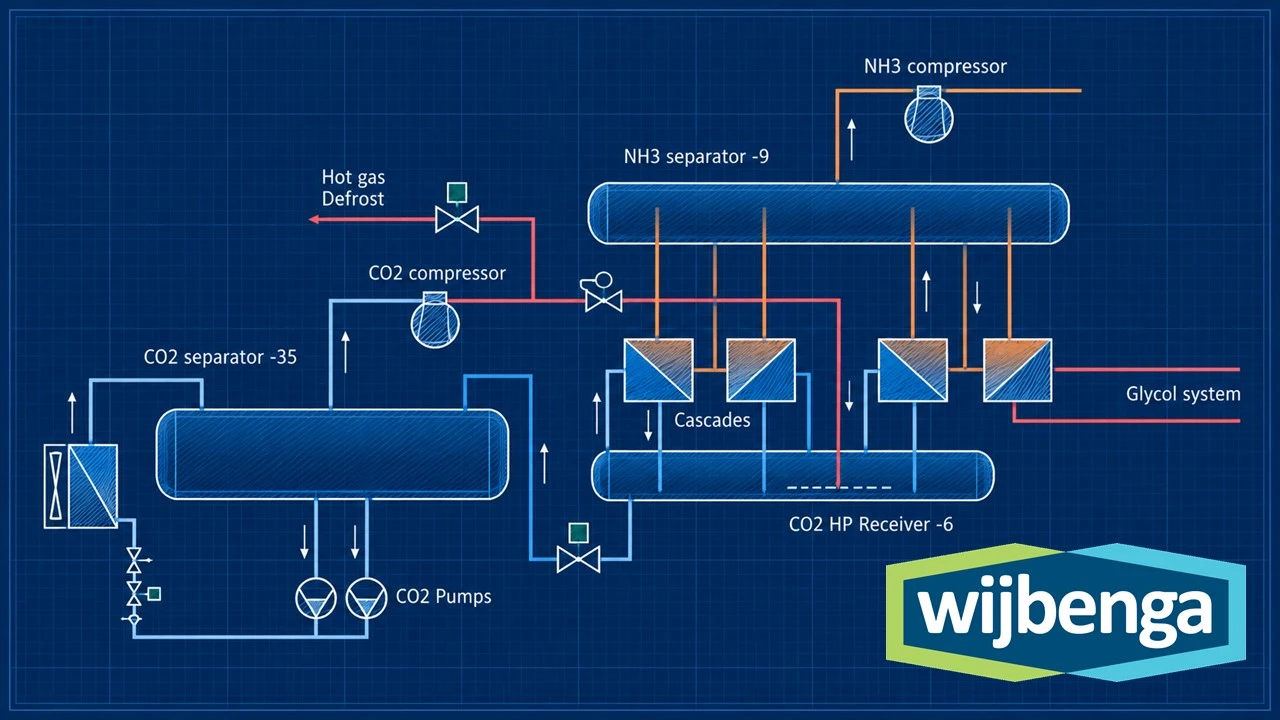
In the cascade system, ammonia provides refrigeration on the primary side, while CO₂ is used to distribute cooling throughout the freezer rooms.
Three cascade heat exchangers, each with a capacity of 800 kW, connect the two refrigerant circuits. An additional 500 kW glycol heat exchanger is also incorporated.
The CO₂ circuit uses pumped refrigerant circulation with WITT refrigerant pumps. By keeping the ammonia side compact and using CO₂ for distribution, the NH₃ charge remains below 1,500 kg.
 Wijbenga's contribution: technical expertise and customised solutions
The performance and operational reliability of an industrial refrigeration system depend largely on the correct sizing and integration of its components.
Wijbenga contributed technical expertise to the selection and engineering of key system components and coordinated their supply in cooperation with specialised manufacturers.
Key components
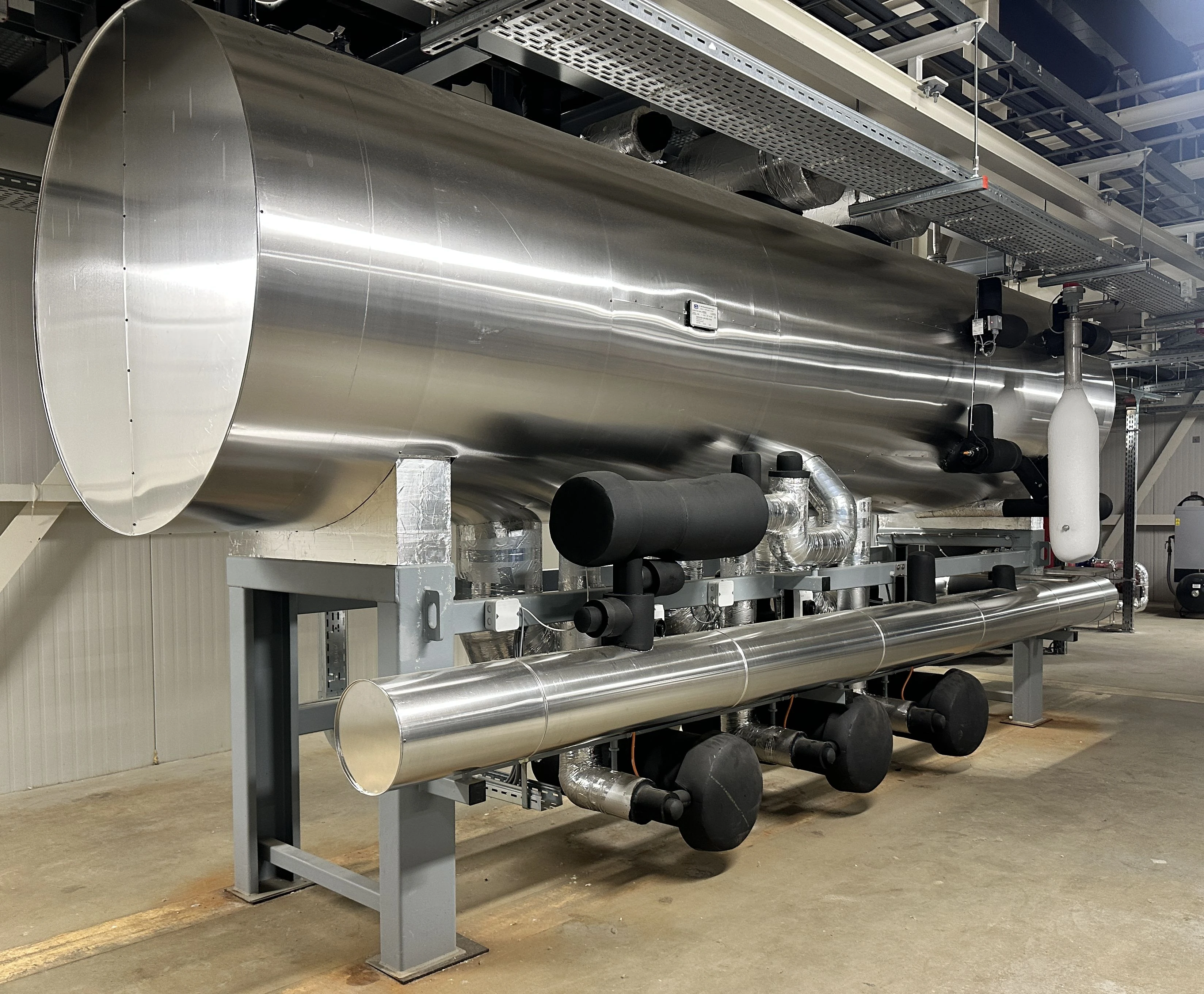
- NH₃ separator: 2,900 kW at −9°C, equipped with a dual WITT HAM 1200 separation system. A customised solution with a separator length of over six metres.
- Heat exchangers: three Alfa Laval MK15 cascade heat exchangers rated at 800 kW each, plus a 500 kW glycol heat exchanger.
- CO₂ vessels: a high-pressure receiver and a CO₂ separator to ensure reliable liquid refrigerant management and distribution.
- CO₂ pump system: three WITT NRP3/12 refrigerant pumps, selected for a circulation ratio of 1.5 and a required pump head of 50 metres.
Tight schedule, direct communication
Early technical involvement is essential for a project with such a demanding timeline.
By closely coordinating component selection, technical engineering and delivery planning, the main components were delivered as early as June 2025. The refrigeration system became operational in early 2026.
Intelligent energy management
Energy management also plays an important role. The new cold storage facility features almost 5,000 solar panels with a combined peak capacity of 3 MWp.
By making use of the thermal mass of the stored products, cold energy can be buffered when solar power is available or electricity prices are favourable.
During periods of high energy prices or peak grid demand, refrigeration output can be reduced while maintaining temperatures within the permitted limits.
In this way, the system design contributes to energy-efficient operation.
The result: technology and collaboration
The result is a future-proof refrigeration system combining natural refrigerants, a limited ammonia charge and reliable refrigerant distribution.
This project demonstrates where Wijbenga makes the difference: translating technical challenges into practical solutions through specialist expertise, customised engineering and reliable supply.